

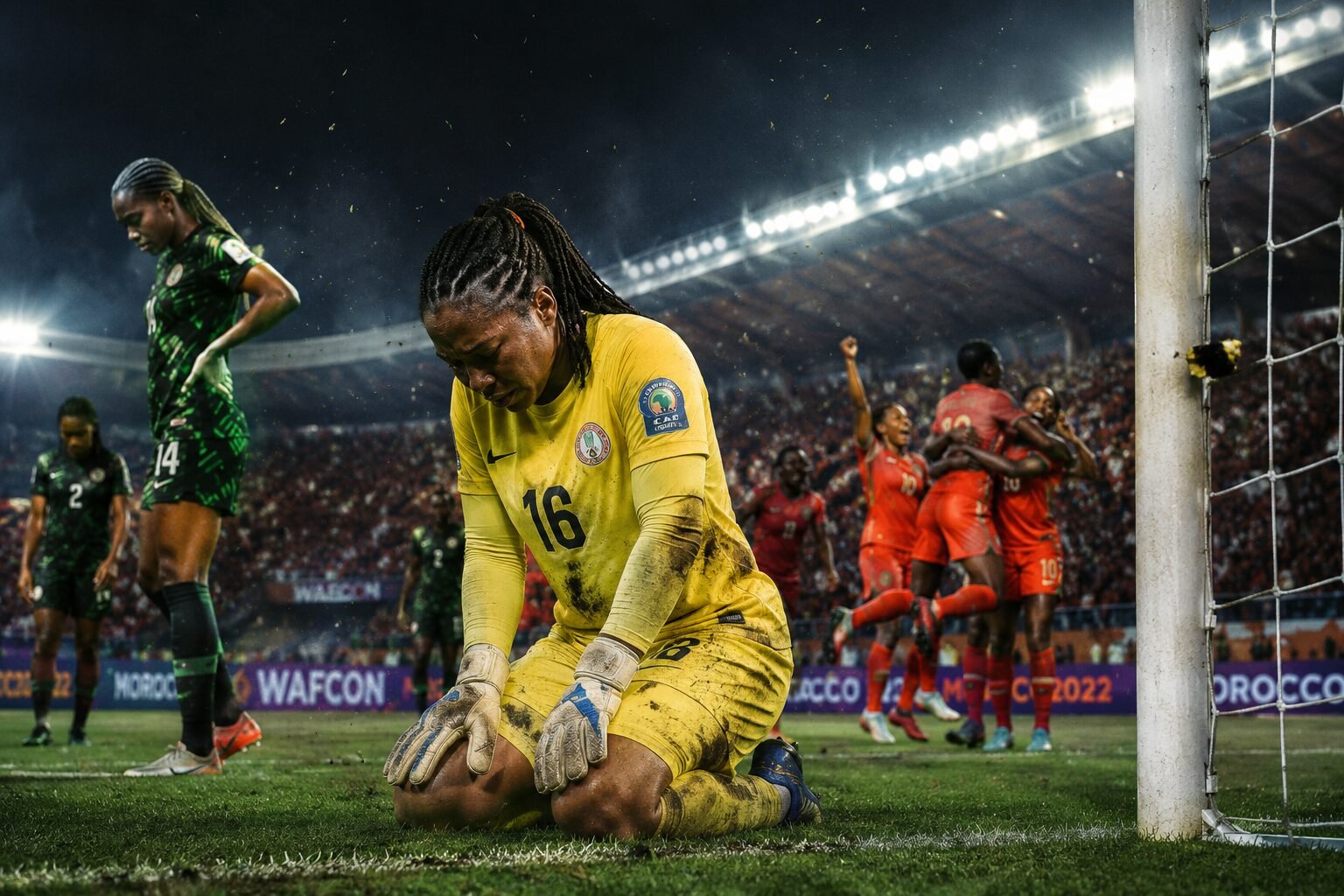
Wake Up Call for Nigeria: What Went Wrong in the Super Falcons’ Defeat to Malawi?
Nigeria’s 3–2 defeat to Malawi in their opening match of the 2026 CAF Women’s Africa Cup of Nations was more than an unexpected result. It was a serious warning to the defending champions.
The Super Falcons entered the competition as 10 time African champions and one of the favourites to retain the title. Malawi, meanwhile, were playing their first match at a Women’s Africa Cup of Nations. Yet it was the debutants who showed greater discipline, sharper decision making and more determination when the match entered its decisive stages.
After a goalless first half, Malawi scored three times in the second half through Temwa Chawinga and Tabitha Chawinga. Nigeria responded with a Rasheedat Ajibade penalty and a late goal from Uchenna Kanu, but the comeback came too late.
This defeat should not lead to panic, but it must lead to honest reflection. Nigeria still possess the experience and individual quality to recover, but reputation alone will no longer win matches in African women’s football.
Nigeria Controlled Possession but Not the Match
One of the biggest problems was the difference between having the ball and controlling the game.
Nigeria enjoyed periods of possession and territorial dominance, particularly before Malawi opened the scoring. However, the Super Falcons struggled to convert that possession into clear scoring opportunities. Malawi remained compact, protected the central areas and waited for opportunities to counterattack through the pace of the Chawinga sisters.
Nigeria’s attacking play was often predictable. The ball moved across the midfield and defensive lines, but there was insufficient movement behind Malawi’s defence. The Falcons lacked quick combinations around the penalty area and rarely forced Malawi’s defenders to turn toward their own goal.
The longer the game remained scoreless, the more confident Malawi became.
Nigeria appeared to believe that a goal would eventually come because of their superior possession and individual talent. Malawi, however, had a clear strategy. They defended patiently, targeted the space behind Nigeria’s backline and attacked quickly whenever possession changed.
That tactical discipline ultimately made the difference.
Defensive Errors Exposed Nigeria
The most worrying part of the performance was not simply that Nigeria conceded three goals. It was the manner in which the goals were conceded.
Malawi repeatedly attacked the space behind Nigeria’s defensive line using direct passes and quick transitions. Nigeria’s defenders were often positioned too high, while the midfield failed to provide adequate protection when possession was lost.
Poor Defensive Positioning
Nigeria’s defensive line struggled to maintain the correct distance between the centre backs, full backs and midfielders.
When Nigeria pushed forward, too many players moved ahead of the ball. Once possession was lost, Malawi had open spaces to attack. The defenders were forced to retreat while facing their own goal, which gave Temwa and Tabitha Chawinga the advantage.
The Chawinga sisters are among the most dangerous attacking players in African football. Giving them space to run into was always going to be risky.
Nigeria should have adjusted after Malawi demonstrated their counterattacking threat in the first half. Instead, the same spaces remained available during the second half.
Failure to Track Runners
The Falcons also failed to track Malawi’s attacking runs consistently.
For the first two goals, Malawi’s forwards were able to attack direct passes without sufficient pressure from Nigeria’s defenders. The communication between the centre backs and full backs appeared uncertain. One defender would step forward while another dropped back, creating gaps and breaking the defensive line.
Defending is not only about tackling. It is also about anticipation, communication and positioning.
Nigeria reacted to Malawi’s attacks rather than preventing them.
Inadequate Protection from Midfield
The defence should not carry all the blame.
Nigeria’s midfielders did not provide enough protection when the team lost possession. There was limited pressure on the player delivering the long passes, allowing Malawi time to identify and release the Chawinga sisters.
A high defensive line can work, but only when the midfield presses the ball aggressively. When the player in possession is allowed time to look up and make a pass, defenders become vulnerable to runs behind them.
Nigeria’s press was often uncoordinated. One player applied pressure while others remained too far away. Malawi were therefore able to escape the first challenge and attack the exposed defence.
Poor Game Management
Nigeria’s third concession was especially concerning because it came shortly after Ajibade’s penalty had reduced the deficit to 2–1.
At that moment, Nigeria had momentum and still had an opportunity to equalize. The priority should have been to maintain defensive stability while continuing to apply controlled pressure.
Instead, Nigeria became overly aggressive and immediately surrendered another goal. Temwa Chawinga took advantage of poor positioning to score Malawi’s third in stoppage time.
That was a failure of game management.
Experienced teams must understand when to attack, when to slow the game down and when to avoid unnecessary risks. Nigeria’s urgency became desperation, and Malawi punished it.
Goalkeeping Errors Proved Costly
Chiamaka Nnadozie has been one of Nigeria’s most reliable players for several years. She has produced important saves in major tournaments and remains one of Africa’s leading goalkeepers.
However, this was a difficult match for her.
Misjudging the First Goal
Malawi’s opening goal came after a long pass behind Nigeria’s defence. Nnadozie moved away from her goal to deal with the danger but miscalculated the flight and timing of the ball.
Temwa Chawinga reached it first, moved beyond the goalkeeper and finished into the open net.
Goalkeepers are expected to act as sweepers when their teams defend with a high line. However, the decision to leave the penalty area must be clear and decisive.
The goalkeeper has three basic options in that situation:
- Reach the ball first and clear it.
- Remain closer to goal and narrow the shooting angle.
- Communicate early so a defender can deal with the danger.
Nnadozie became caught between the first two options. Once she hesitated, Temwa gained control of the situation.
Vulnerability for the Second Goal
For Malawi’s second goal, another direct pass exposed Nigeria’s defence. Tabitha Chawinga finished through Nnadozie’s legs.
Although the defensive line allowed the opportunity to develop, the goalkeeper could have made herself more difficult to beat.
In one against one situations, goalkeepers must remain balanced, avoid committing too early and reduce the available shooting angle. Opening the legs while moving forward created a clear finishing opportunity.
Again, the error began with the defence, but the final attempt was still saveable.
Positioning for Malawi’s Third Goal
The third goal was another example of questionable positioning.
Nigeria had pushed players forward after scoring from the penalty spot. Nnadozie was positioned away from her goal and Temwa Chawinga recognized the opportunity, lifting the ball into the unprotected net.
The decision to advance may have been intended to support Nigeria’s high defensive line, but the risk was not properly managed.
A goalkeeper must constantly assess the position of the ball, the defensive pressure on the opponent and the location of the goal. When there is little pressure on the attacker, standing too far away from goal becomes dangerous.
Nnadozie Should Not Carry the Blame Alone
It would be unfair to blame the entire defeat on the goalkeeper.
Nnadozie also intervened earlier in the match when Malawi threatened Nigeria’s goal. Channels Television reported that she rescued Nigeria during a dangerous first half attack.
Goalkeeping mistakes are more visible than mistakes made elsewhere on the field. However, each Malawi goal developed because Nigeria’s defensive structure had already broken down.
The goalkeeper made poor decisions, but the defenders failed to manage the space, the midfield failed to stop the passes and the team failed to react tactically.
The defeat was collective.
Malawi Deserve Full Credit
Nigeria’s poor performance should not take anything away from Malawi.
The Scorchers were organised, brave and tactically disciplined. They understood that Nigeria would control possession, but they remained patient and protected the areas that mattered most.
Their forwards were direct and decisive. Whenever Nigeria lost the ball, Malawi immediately looked for Temwa and Tabitha Chawinga.
The sisters demonstrated excellent movement, speed and finishing. Temwa scored twice, including Malawi’s opening and decisive third goals, while Tabitha scored the second.
Malawi did not win through luck. They identified Nigeria’s weaknesses and repeatedly exploited them.
Their victory also demonstrated how much African women’s football has developed. Smaller nations are becoming more competitive, players are gaining experience in stronger leagues and tactical preparation is improving.
Nigeria can no longer expect opponents to be intimidated by their history.
Questions for Coach Justine Madugu
Coach Justine Madugu must accept responsibility for the team’s inability to adjust.
Malawi’s counterattacking approach was visible before the opening goal. The warning signs were present in the first half, but Nigeria continued to defend with considerable space behind the backline.
The coaching team should have made several adjustments:
- A defensive midfielder could have been instructed to remain deeper.
- The full backs could have advanced one at a time instead of simultaneously.
- The centre backs could have dropped several metres to reduce the space behind them.
- Greater pressure could have been applied to Malawi’s passers.
- Nigeria could have used quicker attacking combinations instead of committing more players forward without creating clear chances.
Substitutions should also change the structure of a team, not simply replace one player with another.
When Toni Payne entered in the second half, Nigeria were still searching for the opening goal. However, the Falcons needed more than additional attacking talent. They needed better balance between attack and defence.
The coaching staff must now demonstrate that they can identify problems and correct them quickly.
What Should Nigeria Do Next?
Nigeria’s next match against Zambia on August 1 is now extremely important. Zambia opened their campaign with a 6–0 victory over Egypt, meaning Nigeria cannot afford another careless performance.
Several immediate changes are required.
1. Restore Defensive Discipline
Nigeria must begin with a compact defensive structure.
The distance between the midfield and defence must be reduced. Malawi found too much space between the lines and behind the defenders.
Against Zambia, this would be even more dangerous because Zambia possess fast, powerful forwards who can punish any defensive hesitation.
The Falcons should consider defending slightly deeper, particularly during the early stages of the match. There is no need to expose the defence while chasing an early goal.
2. Improve Communication
The goalkeeper, centre backs and defensive midfielders must communicate continuously.
They need clear instructions regarding:
- Who challenges the ball
- Who covers the space behind
- When the defensive line moves forward
- When the goalkeeper leaves her area
- Who tracks each attacking runner
Several of the errors against Malawi appeared to result from uncertainty rather than a complete lack of ability.
Communication can reduce that uncertainty.
3. Protect the Defence with a Dedicated Midfielder
Nigeria may need a more defensive midfield structure.
One midfielder should remain in front of the centre backs and provide protection when the full backs move forward. This player should also track runners and challenge opponents before they can deliver passes behind the defence.
The Falcons cannot continue attacking with six or seven players while leaving the remaining defenders exposed.
4. Press as a Team
Pressure must be coordinated.
When one Nigerian player closes down the opponent, the surrounding players must also reduce the available passing options. Otherwise, the opponent can easily pass around the first challenge.
Nigeria should decide whether to press high or defend in a medium block. A poorly organized press is worse than no press because it creates gaps throughout the team.
5. Make Better Decisions in Goal
Nnadozie should remain Nigeria’s goalkeeper unless the coaching staff identify a physical or confidence related concern.
One poor performance should not erase her previous contributions. However, she must review each goal honestly with the goalkeeping coach.
The focus should be on:
- Starting position
- Timing when leaving the goal
- Body shape during one against one situations
- Communication with defenders
- Decision making when Nigeria use a high defensive line
The objective is not punishment. It is correction.
6. Increase Attacking Speed
Nigeria must move the ball more quickly.
Possession without penetration allowed Malawi to settle into their defensive shape. The Falcons need quicker passes, greater movement between the lines and more runs behind the defence.
Wide players should attack defenders directly, while midfielders should make late runs into the penalty area.
Nigeria also need to improve the quality of their final pass. Too many promising attacks ended with an inaccurate cross or a delayed decision.
7. Start Matches with Greater Urgency
The Falcons cannot wait until the final minutes before playing with intensity.
Both Nigerian goals arrived in stoppage time. Ajibade converted a penalty in the 92nd minute, while Kanu scored in the 99th minute.
That late response showed that the team still possessed fighting spirit, but the urgency arrived too late.
Nigeria must play from the opening whistle with the same determination normally seen when defeat appears unavoidable.
8. Select Players Based on Tactical Needs
The coaching staff should avoid selecting players only because of reputation or experience.
The starting lineup must reflect the demands of each opponent.
Against a team with fast forwards, Nigeria need defenders who are comfortable defending open spaces. Against a compact opponent, the team needs creative midfielders and attackers capable of operating in tight areas.
The best individual players do not always produce the best balanced team.
This Defeat Can Still Become Valuable
Tournament champions are not always the teams that avoid every setback. They are often the teams that respond most effectively when problems appear.
Nigeria’s defeat has exposed weaknesses early enough for them to be corrected.
The Falcons now know that their defensive positioning is vulnerable, their counterpressing needs improvement and their goalkeeper and defenders require better coordination.
The coaching staff also have an opportunity to evaluate the team without the comfort of an easy opening victory.
If Nigeria respond with discipline and humility, the Malawi defeat could become the moment that transforms their campaign.
However, if the team dismisses the result as an accident, the consequences could be serious.
A Wake Up Call for Nigerian Football
The result should also encourage a wider conversation about the development of Nigerian women’s football.
Nigeria’s historical dominance cannot be maintained through talent alone. Other African countries are investing in coaching, player development, scouting, sports science and tactical preparation.
The Super Falcons need regular high quality friendly matches, improved preparation before tournaments and a stronger pipeline of defenders, midfielders and goalkeepers capable of competing at international level.
Players representing leading clubs around the world must also be given a national team structure that allows them to perform effectively together.
Nigeria’s strength has traditionally come from individual quality, physical ability and resilience. Those qualities remain important, but modern football also requires tactical detail, coordinated pressing, positional discipline and intelligent game management.
The 3–2 defeat to Malawi was historic for the wrong reasons. It was Nigeria’s first WAFCON defeat to a tournament debutant and a damaging beginning to their title defence.
The result exposed defensive confusion, poor protection from midfield, questionable goalkeeping decisions and an inability to adjust to Malawi’s counterattacking threat.
But the tournament is not over.
Nigeria still have the players, experience and fighting spirit to recover. The response must begin with accountability. The coaches must adjust the tactics, the defenders must improve their communication, the midfield must protect the backline and the goalkeeper must correct her decision making.
Most importantly, the Super Falcons must approach every opponent with respect.
Malawi showed that history does not defend, reputation does not score and championships are not won by past achievements.
For Nigeria, the message is clear.
Wake up, correct the mistakes and respond like champions.
Read Also :
Fazili hails blend of youth, experience after Malawi’s historic upset over Nigeria – soccervar.com
Nigeria’s 11-Title hunt begins: Why the Super Falcons won’t struggle out of Group C – soccervar.com