Video Assistant Referee, or VAR, was introduced to make football fairer. It has done that, but at a cost the sport is still struggling to measure.
Few innovations in football have changed the game more dramatically or divided opinion more deeply. To some, VAR is a necessary correction in a sport that could no longer afford obvious officiating mistakes in the age of endless replays. To others, it is a technological fix that has made football more sterile, more fragmented, and less emotionally honest. Both arguments contain truth.
What is beyond dispute is this: VAR was born from a real problem. Referees were being asked to make decisive calls in real time, under extreme pressure, while millions of viewers could immediately replay the same incident from multiple angles. In that environment, the old expectation that referees should simply “live with” major mistakes became harder to defend.
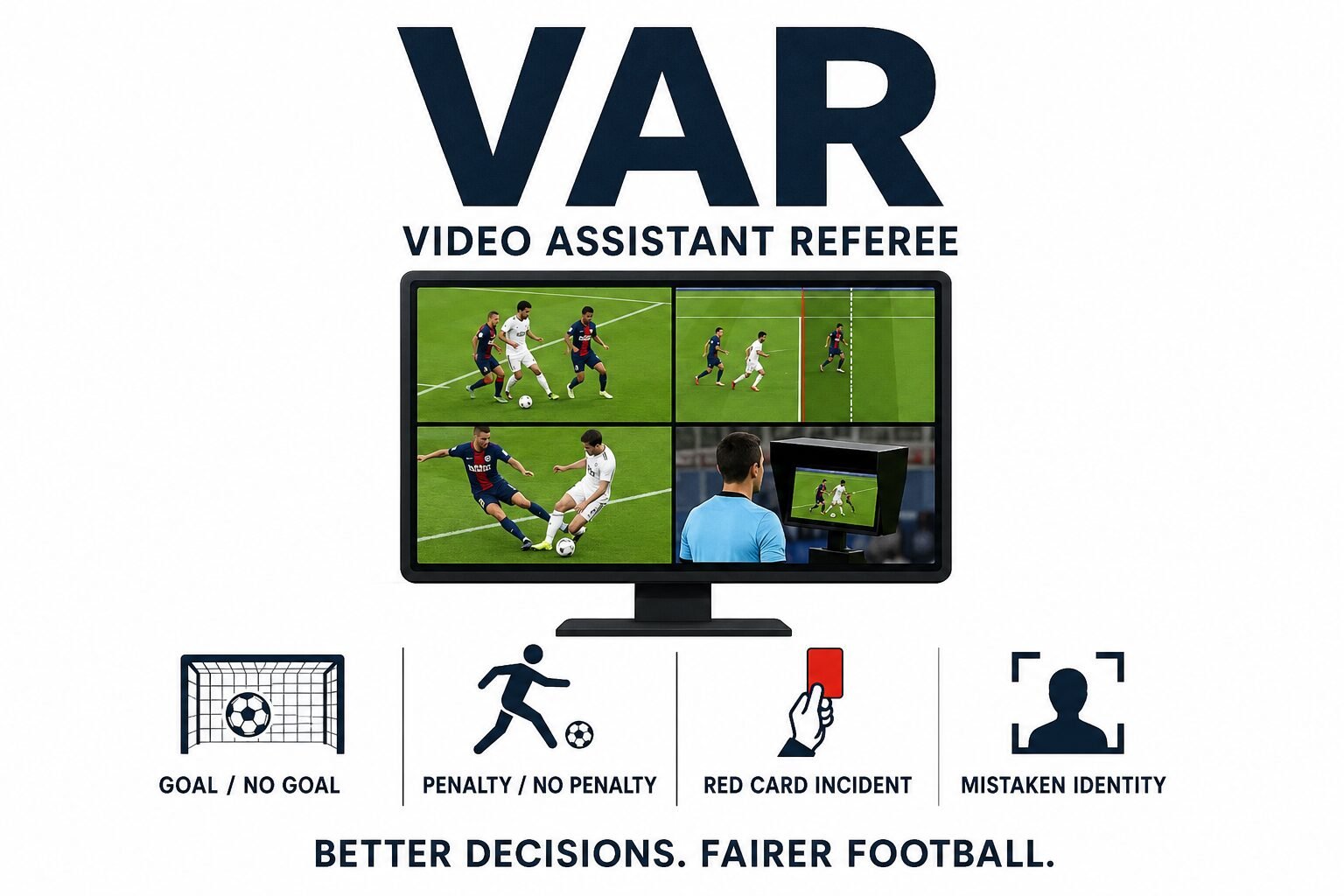
Yet VAR was never meant to referee football by remote control. Under the official IFAB VAR protocol, its role is tightly limited. It may intervene only in cases involving goal or no goal, penalty or no penalty, direct red card incidents, and mistaken identity. Even then, the standard is not ordinary error, but a “clear and obvious” one. The referee remains the final decision-maker. That principle matters, because it reminds us that football has not handed control to machines. It has, instead, created a technological backstop for the most consequential moments in a match.
Why VAR Was Inevitable
The origins of VAR are often linked to the Royal Netherlands Football Association’s Refereeing 2.0 project in the early 2010s. The KNVB later confirmed that the initiative developed into a more focused effort to build what became the video assistant referee system (KNVB). But the deeper origin of VAR was not administrative. It was cultural.
Football had reached the point where the gap between what viewers could see and what referees could judge had become too wide. Missed handballs, incorrect penalties, wrongly disallowed goals, and obvious red-card incidents did more than change results. They damaged trust. Supporters, players, and pundits were no longer merely complaining about bad luck; they were questioning whether the sport’s decision-making structure still matched the realities of modern broadcasting.
In that sense, VAR was inevitable. Once football had the tools to catch major errors, refusing to use them became harder to justify.
The Promise and the Problem
The case for VAR is straightforward. It improves the chances of getting the biggest decisions right. It offers referees support in a game where every controversial call is replayed instantly, slowed down, freeze-framed, and dissected in public. It also acts as a deterrent. Players know that violent conduct, simulation, and off-the-ball incidents may not go unseen.
FIFA states that VAR was formally added to the Laws of the Game for the 2018/19 season after testing and approval processes (FIFA VAR Technology). Its arrival at the 2018 FIFA World Cup in Russia marked the moment it moved from experiment to reality. That tournament, the first men’s World Cup to use VAR throughout, showed both the value and the limitations of the system. It corrected major errors. It also introduced long pauses, uncertainty, and a new kind of tension that many supporters found unnatural.
That remains the central contradiction of VAR. It makes football more accurate, but not necessarily more satisfying.
Football is not only a contest of rules. It is also a contest of rhythm, emotion, and instinct. A late goal is not merely an event to be verified; it is a release of energy in the stadium and on the pitch. VAR has altered that experience. Goals are now celebrated with caution. Joy is delayed by suspicion. The crowd waits not only for the ball to hit the net, but for the technology to confirm that the emotion is valid.
Supporters may accept that trade-off in the name of fairness. But they are right to feel that something has changed.
What VAR Is and What It Is Not
Much of the public frustration around VAR comes from misunderstanding its limits. VAR is not there to review every foul, every corner, every second yellow card, or every subjective complaint. Its remit is deliberately narrow. It applies only to major match-changing incidents: goals, penalties, direct red cards, and mistaken identity. That restraint reflects the system’s founding principle of minimum interference and maximum benefit.
Operationally, the process is straightforward. VAR works from a Video Operation Room, where the video team has access to broadcast feeds and communicates with the referee through the match officials’ communication system. Every reviewable incident is checked, but most checks do not stop the game. Only when there may have been a clear and obvious error does the process escalate. For factual issues such as offside or whether an offence occurred inside or outside the penalty area, the referee may accept the VAR’s information directly. For subjective matters, the referee will usually conduct an on-field review.
The essential point is that VAR is an assistant, not a substitute referee. Football has preserved the authority of the official on the pitch, even as it has surrounded that official with more information than ever before.
Uneven Adoption, Uneven Experience
VAR’s spread through football has been broad but uneven. Elite competitions adopted it first because they had the financial and technical capacity to do so. Serie A, the Bundesliga, La Liga, the Premier League, UEFA competitions, and major international tournaments incorporated VAR in stages, but no two implementations were exactly alike. Camera coverage, referee training, communication protocols, and stadium infrastructure all influenced the quality of the system in practice.
FIFA later formalised two broad approaches through its Quality Programme: full VAR systems, which use at least four cameras and often many more, and VAR Light, which uses four to eight cameras and is intended for competitions with fewer resources (FIFA VAR Technology). FIFA has also promoted Football Video Support, or FVS, as a lower-cost option for competitions with limited means. Crucially, FIFA has stressed that FVS is not VAR. It does not involve continuous monitoring by dedicated video match officials; instead, coaches request reviews in specified situations (FIFA FVS).
This matters because the debate over VAR is not only about whether the system is desirable. It is also about whether it is equally available, equally reliable, and equally well understood across different levels of the sport.
The Consistency Problem
If delay is the most visible criticism of VAR, consistency is the most serious one.
VAR was supposed to correct clear and obvious errors. In practice, however, football still struggles to agree on what “clear and obvious” means. Handball decisions remain contentious because the law itself relies on interpretation of movement, body shape, and intent. Offside decisions, meanwhile, have created a different kind of unease: the sense that the technology is sometimes too precise for the spirit of the game, ruling out goals for margins invisible to the naked eye.
This has produced a paradox. VAR was introduced to reduce controversy, but in some areas it has simply relocated controversy from the referee’s first decision to the replay room’s final one.
That does not mean the technology has failed. It means football has discovered something uncomfortable: better evidence does not eliminate disagreement. It only changes the terms of it.
How the Game Has Changed Around VAR
Players, referees, and supporters have all adjusted. Defenders are more careful in the penalty area. Goalkeepers are more conscious of encroachment on penalties. Attackers know that a goal may still be disallowed for an offside or handball earlier in the move. Assistant referees are routinely instructed to delay the flag in attacking situations so that promising moves are not stopped prematurely. Referees must now manage not only the match itself but also a constant stream of information from the VAR team.
Supporters have had the most ambivalent adaptation of all. In some countries, VAR is increasingly treated as part of the accepted architecture of elite football. In others, it remains a weekly grievance. The difference often comes down to communication. Fans can tolerate delay more easily when they understand what is being checked and why. Where that explanation is absent, frustration fills the gap.
The Next Stage: Semi-Automation and the 2026 World Cup
If the first era of VAR was about introducing video review, the next era is about making it faster and less intrusive.
One of the most significant advances has been semi-automated offside technology. At the 2022 FIFA World Cup, FIFA used tracking cameras and connected ball technology to support quicker and more accurate offside decisions. FIFA explained that the system combined tracking data, artificial intelligence, and a sensor inside the ball to identify player positions and the exact kick point (FIFA SAOT 2022). Even then, the process did not bypass officials; video match officials still had to validate the recommendation before the referee confirmed it.
The 2026 FIFA World Cup has pushed that model further. FIFA confirmed that the tournament would introduce advanced semi-automated offside technology at a men’s World Cup for the first time, together with improved referee body camera images and expanded match analysis tools for all 48 teams (FIFA 2026 Innovation). The most significant development is speed. FIFA explained that, unlike the 2022 model in which offside data first went to the VAR, clear offside alerts in 2026 can now be transmitted directly to match officials on the field. In tighter or more complex cases, the VAR still validates the decision before it is finalised.
That may sound like a technical detail, but it has practical importance. Delayed flags can expose players to unnecessary risk by allowing play to continue in situations where an attacker is clearly offside. Faster alerts reduce those avoidable sequences.
The 2026 tournament also uses connected ball technology to identify the precise moment the ball is played, strengthening the accuracy of semi-automated offside decisions (FIFA Connected Ball Technology). FIFA’s Referee View system adds another layer, using a small body camera worn by the referee to capture the official’s perspective (FIFA Referee View). FIFA and Lenovo have also announced AI-powered stabilisation software to improve that footage in real time for audiences (FIFA and Lenovo). FIFA has further confirmed that the Video Operation Room at the International Broadcast Centre in Dallas functions as the central hub of the tournament’s officiating technology, integrating VAR, goal-line technology, connected ball data, semi-automated offside systems, and player and ball tracking (FIFA Match 1000).
Taken together, these changes suggest that football’s future is not less technological, but more. The real question is whether that technology can become subtle enough to support the game without overwhelming it.
Football’s Real Challenge
The debate over VAR is no longer about whether football should use technology. That argument has effectively been settled. The sport has gone too far down that road, and the logic behind the change is too strong to reverse. Too much is at stake, competitively, financially, and reputationally, for football to return willingly to an era in which obvious injustices were accepted as part of the spectacle.
The real challenge now is governance.
Football must decide how much intervention is too much, how much precision is useful before it becomes absurd, and how transparent the process must be if public trust is to be preserved. Accuracy matters, but so does legitimacy. A decision can be technically correct and still leave players and supporters dissatisfied if the process feels opaque, overlong, or detached from the spirit of the game.
That is the unresolved issue at the heart of VAR. The technology has improved football’s ability to detect mistakes. It has not yet fully solved football’s ability to live with the corrections.
Conclusion
VAR was introduced to protect football from avoidable injustice, and in that respect it has succeeded. It has corrected major mistakes, improved the evidential basis of refereeing, and brought the sport into closer alignment with the realities of the broadcast age. But it has also changed the emotional grammar of football. It has inserted hesitation into celebration, procedure into spontaneity, and technical review into moments that once belonged entirely to instinct.
That is why the argument over VAR persists. It is not merely a dispute about technology. It is a dispute about what football wants to be.
At the 2026 FIFA World Cup, with advanced semi-automated offside technology, connected ball data, improved referee body cameras, and centralised video operations, football is making its answer clear. The sport is not retreating from technological officiating. It is refining it.
Whether that refinement ultimately strengthens the game will depend on a balance football has not yet fully mastered: using technology to serve justice without allowing it to dominate the experience. VAR is no longer on trial. The way football chooses to govern it still is.