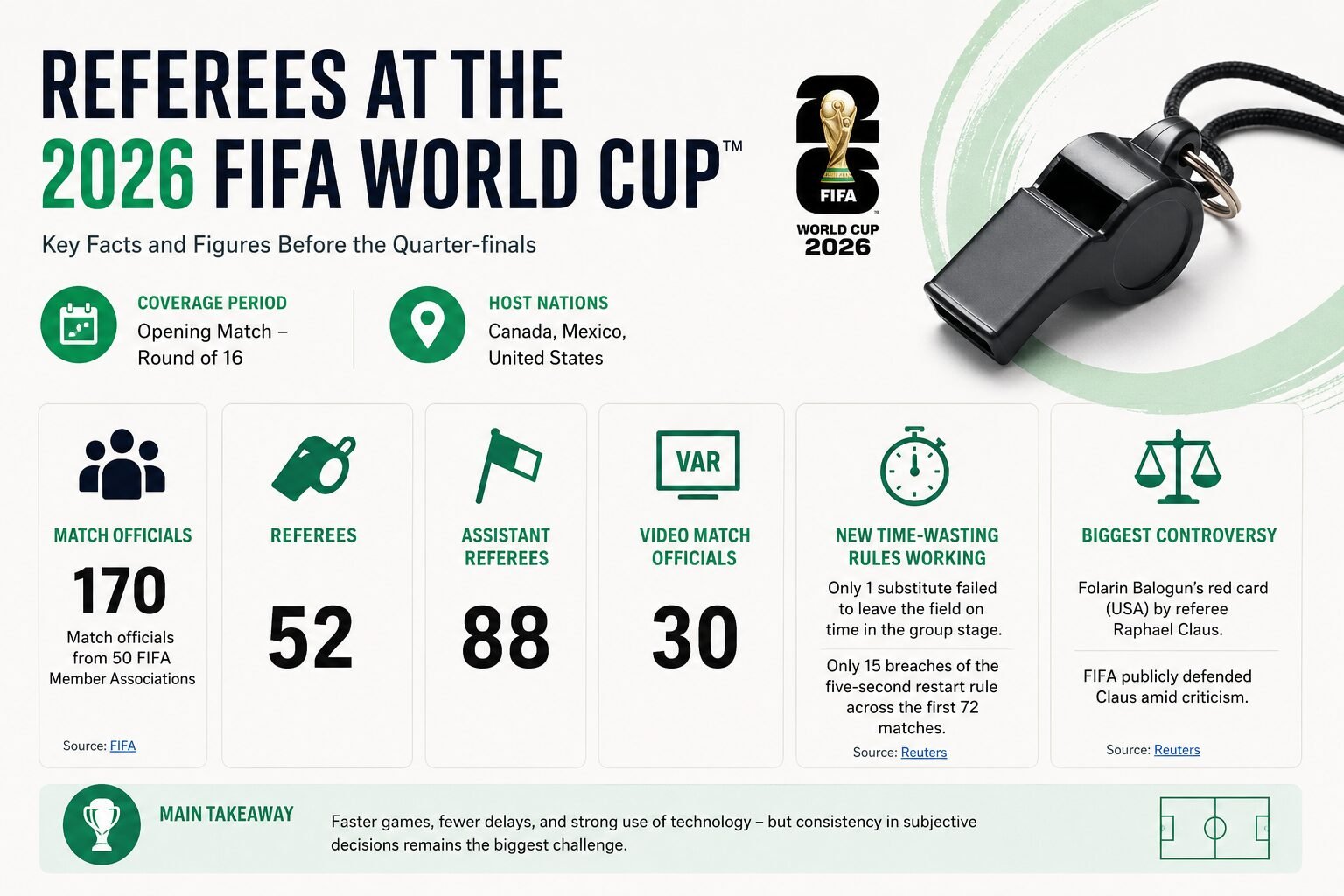
An Investigative Analysis of Officiating from the Opening Match to the End of the Round of 16
Introduction
The 2026 FIFA World Cup has rewritten football history in many ways. It is the first tournament featuring 48 teams, the first to be hosted jointly by Canada, Mexico, and the United States, and the largest FIFA World Cup ever staged.
While the spotlight naturally falls on players and coaches, another group has quietly carried an enormous responsibility: the referees.
Every major tackle, penalty appeal, offside decision, VAR review, and red card has been scrutinized by millions of supporters. In a tournament featuring more matches, more teams, and unprecedented technological support, referees have arguably experienced their toughest World Cup assignment yet.
As the tournament reaches the quarter-final stage, it is appropriate to assess how well match officials have performed.
Have FIFA’s new rules improved the game?
Has VAR become more consistent?
Are referees allowing football to flow more naturally?
Or has inconsistency remained football’s biggest officiating problem?
This investigation evaluates the performances of referees from the opening match through the completion of the Round of 16.
The Biggest Officiating Challenge in World Cup History
The expansion from 32 to 48 nations fundamentally changed the referee’s workload.
Instead of managing 64 matches as in previous editions, officials must now oversee 104 matches, increasing the physical and psychological demands placed on referees.
Recognizing this challenge, FIFA selected the largest refereeing team in World Cup history.
According to FIFA, the tournament features:
- 52 referees
- 88 assistant referees
- 30 Video Match Officials (VMOs)
drawn from 50 FIFA Member Associations after an evaluation program lasting more than three years.
The appointments reflected FIFA’s emphasis on merit, consistency, physical fitness, and experience in elite international competitions.
Unlike previous tournaments, referees also underwent extensive preparation on newly introduced laws intended to speed up football and reduce unnecessary interruptions.
FIFA’s New Philosophy: Let Football Flow
Perhaps the biggest refereeing change in 2026 has not been technological.
Instead, it has been philosophical.
Pierluigi Collina, chairman of FIFA’s Referees Committee, instructed officials to avoid stopping play for minor contact and to focus on maintaining the rhythm of matches whenever possible.
Rather than whistle every collision, referees were encouraged to distinguish between genuine fouls and normal physical contests.
The result has been a noticeably faster World Cup.
Reuters reported that officials have been deliberately avoiding “trifling fouls,” allowing longer passages of uninterrupted football and increasing effective playing time.
For supporters frustrated by constant interruptions in previous tournaments, this represents one of FIFA’s most successful officiating initiatives.
The New Laws Changing Refereeing
Several law amendments debuted during the tournament.
Among the most significant were:
Five-second restart rule
Goalkeepers and throw-ins are now expected to restart play much quicker.
The objective is simple:
Reduce unnecessary delays.
Speed up football.
Increase entertainment.
Ten-second substitution rule
Players leaving the field after being substituted now have only 10 seconds to exit.
Officials may punish deliberate delays with disciplinary action.
The rule prevents teams from wasting time late in matches.
Expanded VAR powers
VAR continues reviewing:
- Goals
- Penalties
- Direct red cards
- Mistaken identity
However, FIFA also improved communication protocols between on-field referees and Video Match Officials.
Officials received extensive pre-tournament training to ensure faster reviews and fewer interruptions.
Has the Time-Wasting Crackdown Worked?
The answer appears to be yes.
According to FIFA Chief Refereeing Officer Pierluigi Collina:
- Only one substitute failed to leave the field within the required time during the group stage.
- Officials recorded only 15 violations of the new five-second restart rule across the first 72 matches.
Collina described the measures as an “overwhelming success,” arguing that the changes significantly improved the tempo of games and reduced frustrating delays.
This represents one of FIFA’s clearest refereeing successes before the quarter-finals.
Technology Continues to Support Referees
VAR remains football’s most controversial innovation.
Yet its importance has become impossible to ignore.
Semi-automated offside technology has dramatically reduced factual offside errors.
Goal-line technology has continued to eliminate uncertainty over whether the ball crossed the line.
Meanwhile, VAR has corrected several clear mistakes involving penalties and red cards.
Although fans often criticize delays, the overwhelming majority of factual decisions now achieve greater accuracy than was possible before technology.
This illustrates an important distinction.
VAR is not designed to eliminate controversy.
It is designed to eliminate obvious officiating mistakes.
Those are two very different objectives.
Visit the IFAB website for the laws of the game
Where VAR Still Divides Opinion
The biggest criticism remains consistency.
Football supporters rarely complain because VAR exists.
They complain because apparently similar incidents sometimes receive different outcomes.
Several incidents during the group stage and Round of 16 reignited debates surrounding subjective interpretation.
Handball decisions.
Serious foul play.
Excessive force.
All remain dependent upon human judgment.
Technology supplies additional evidence.
It does not replace interpretation.
This distinction explains why debates surrounding VAR continue despite improvements in technology.
The Balogun Red Card: The Tournament’s Biggest Refereeing Story
No refereeing incident has attracted more international attention than the dismissal of Folarin Balogun.
Brazilian referee Raphael Claus issued a straight red card following a VAR review after determining Balogun had endangered an opponent with contact to the ankle.
The decision immediately divided football analysts.
Some believed the challenge clearly met the threshold for serious foul play.
Others argued similar incidents elsewhere in the tournament had received only yellow cards.
The debate intensified after FIFA later suspended Balogun’s automatic one-match ban, allowing him to participate in the Round of 16.
The controversy extended beyond football when criticism from political figures prompted FIFA President Gianni Infantino and refereeing chief Pierluigi Collina to publicly defend Claus, describing him as one of FIFA’s elite officials and reaffirming their confidence in his professionalism.
Regardless of personal opinion, the incident became the defining officiating controversy before the quarter-finals.
Coaches Are Still Divided
England manager Thomas Tuchel openly criticized the standard of officiating after England’s Round of 16 victory.
He described refereeing performances as “erratic” and questioned the consistency of major decisions, particularly those involving VAR reviews and disciplinary sanctions.
Such criticism illustrates the continuing challenge for FIFA.
Even when individual decisions are technically correct, perceived inconsistency damages confidence.
That remains the greatest obstacle facing modern officiating.
A More Physical World Cup
One noticeable characteristic of the tournament has been referees allowing greater physical contact.
Officials have consistently resisted stopping games for minimal challenges.
Instead, they have prioritized advantage and game flow whenever possible.
This philosophy has contributed to:
- Longer uninterrupted passages of play
- Faster transitions
- Higher game intensity
- Greater physical battles
- Improved entertainment value
Reuters noted that the “lighter whistle” has become one of the defining features of the tournament, helping create a faster and more dynamic spectacle.
Interim Verdict Before the Quarter-finals
Through the opening match and Round of 16, FIFA’s refereeing strategy has largely achieved its principal objectives.
The tournament has been played at a quicker pace, supported by new laws designed to discourage time-wasting and encourage continuous action. Officials have generally shown confidence in allowing play to continue through minor contact, contributing to a more entertaining spectacle.
At the same time, controversy has not disappeared. High-profile incidents involving VAR, particularly the Balogun dismissal and differing interpretations of serious foul play, have reinforced the view that technology cannot remove subjectivity from football. Public criticism from coaches and political figures has further illustrated the intense pressure under which referees now operate.
Overall, however, the standard of officiating before the quarter-finals has been stronger than many anticipated for the first 48-team World Cup. FIFA’s preparation, investment in technology, and emphasis on game flow have produced encouraging results, even if consistency in subjective decisions remains the game’s biggest refereeing challenge.
Also read :
Portugal 0–1 Spain: Why Portugal Lost, Ronaldo’s Painful Exit and Spain’s World Cup Statement
VAR in Football: Origin, Evolution, Adoption, Usage and the Latest 2026 World Cup Innovations