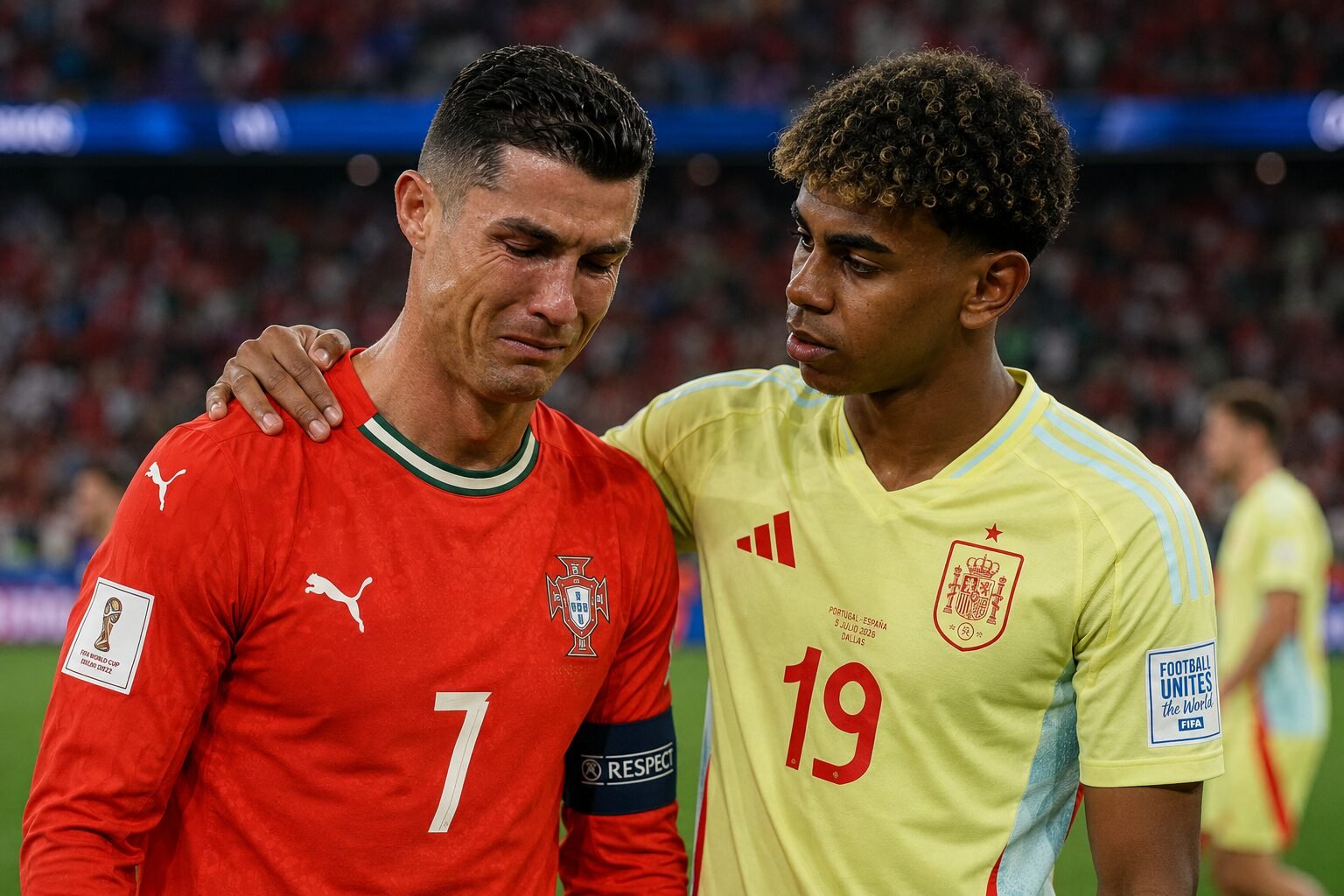
Portugal’s 2026 FIFA World Cup journey ended in heartbreak after a narrow 1–0 defeat to Spain in the Round of 16. In a tense Iberian derby in Dallas, Spain advanced to the quarter finals through a late winner from Mikel Merino, who scored in stoppage time after coming on as a substitute. Reuters reported that Merino scored in the 91st minute after a move involving Ferran Torres, sending Spain through and ending Portugal’s World Cup run.
For Portugal, the defeat was more than a knockout loss. It was also the painful closing chapter of Cristiano Ronaldo’s World Cup story. Ronaldo had already confirmed that the 2026 tournament would be his last World Cup, although he said he would wait before making a final decision on his overall international future.
The match will be remembered for three major questions. Why did Portugal lose? Should Ronaldo have played such a central role? Was Spain truly spectacular, or simply more composed? And does Lamine Yamal now represent the future of Spanish football?
Match Summary: Spain Waited, Portugal Faded
This was not a match full of goals, but it was full of tension. Portugal and Spain both understood the weight of the fixture. It was not just a World Cup knockout game; it was an Iberian rivalry, a meeting of two talented squads, and potentially Ronaldo’s final appearance on the World Cup stage.
The first half was competitive. Portugal had moments where they looked capable of hurting Spain, especially through quick transitions and the technical quality of players such as Bruno Fernandes and Bernardo Silva. Spain, however, gradually gained control as the game progressed. Reuters noted that Spain dominated possession, particularly in the second half, while Portugal relied heavily on defensive resistance and goalkeeper Diogo Costa.
The decisive moment came late. Mikel Merino, introduced from the bench, scored the winner in stoppage time. That timing made the defeat even more painful for Portugal. They had defended for long periods, kept themselves alive, and looked close to forcing extra time. But Spain’s patience was eventually rewarded.
Why Did Portugal Lose?
Portugal did not lose because they lacked talent. They lost because Spain managed the rhythm of the match better, controlled key spaces for longer periods, and had more clarity in the final phase of the game.
Portugal’s biggest problem was that they could not sustain their first half energy. Bruno Fernandes later admitted disappointment that Portugal failed to maintain their first half performance, while also acknowledging Spain’s quality.
That statement captures the match well. Portugal were not poor from the first whistle. They competed. They defended. They had spells of threat. But they gradually became reactive. Spain had more of the ball, more territory, and more belief that one chance would eventually arrive.
1. Portugal became too conservative
Portugal’s approach became increasingly cautious as the match went on. Against a Spain team that thrives on possession and positional control, sitting deeper for too long is dangerous. It invites pressure, reduces counter attacking options, and forces attacking players to start too far from goal.
Portugal had enough individual quality to be braver. With Bernardo Silva, Bruno Fernandes, Rafael Leão, João Félix and others available in the squad, Portugal should not have looked so dependent on isolated moments. The issue was not simply selection; it was the balance between control and courage.
2. Spain controlled midfield better
Spain’s greatest strength was not spectacular attacking football for 90 minutes. It was control. They kept the ball, moved Portugal side to side, and waited for gaps to appear. Even when Spain were not creating clear chances, they were slowly pushing Portugal backwards.
The Guardian described Spain as having midfield dominance, with Rodri regaining form and Lamine Yamal gradually influencing the game. That midfield control became more important as Portugal tired.
3. Portugal lacked a consistent attacking outlet
Portugal’s attack did not carry enough sustained threat. Ronaldo’s presence gave Portugal a focal point, but it also shaped the way they attacked. At 41, he could still occupy defenders and attack crosses, but Portugal needed more movement between the lines and more pace behind Spain’s defence.
When Portugal had the ball, they often lacked the sharpness to move Spain out of shape. Too many attacks slowed down before reaching the penalty area. Spain were able to reset defensively and force Portugal into difficult crossing situations.
4. The late goal exposed Portugal’s passive finish
A stoppage time goal is always painful, but it was not random. Spain had grown into the stronger side. Portugal were trying to survive the final moments rather than win them. Merino’s goal came because Spain still had structure, energy and belief late in the game. Portugal, by contrast, looked like a team waiting for extra time.
Should Ronaldo Have Played?
This is the most emotional question from the match. Cristiano Ronaldo is not an ordinary player. He is Portugal’s greatest football icon, a European champion, a Nations League winner, and one of the most influential forwards in history. Leaving him out of a World Cup knockout match would have been a huge decision.
But football does not judge sentiment. It judges impact.
Ronaldo played in what he confirmed was his final World Cup. Reuters reported that he said Portugal’s decision could wait, but the World Cup chapter was over. That context matters. This was not just a tactical decision. It was also a legacy moment.
The case for playing Ronaldo
There were valid reasons to start him. Ronaldo remains a penalty box threat. He gives Portugal leadership, experience and a psychological edge. Opponents still respect his movement inside the area. In a tight knockout game, one cross, one rebound or one free kick can decide everything.
Portugal also knew Spain would dominate possession at times. In such a match, a clinical finisher can be valuable. Ronaldo’s history in major games meant the decision to play him was understandable.
The case against playing Ronaldo
The tactical problem is that modern knockout football requires constant movement, pressing and transitions. Against Spain, Portugal needed forwards who could stretch the pitch, attack space and press defenders aggressively. Ronaldo’s strengths are now more specific. He can finish chances, but he does not offer the same all round mobility he once did.
That meant Portugal had to adapt around him. The team needed to provide service into the box. When that service did not arrive consistently, Ronaldo became isolated.
The fair conclusion is this: Ronaldo deserved to be involved, but Portugal needed a clearer plan around him. Starting him was not automatically wrong. Keeping the attack so dependent on moments was the bigger issue.
Was Spain Spectacular?
Spain were not spectacular in the way people sometimes expect from a classic Spanish team. They did not overwhelm Portugal with endless chances. They did not produce a 4–0 statement. They did not dominate every minute.
But Spain were mature, patient and tactically superior when it mattered.
Reuters reported that both teams had chances, with Spain testing Diogo Costa through players including Oyarzabal, Yamal and Baena, while Ronaldo was denied by Unai Simón. That shows the game was competitive, not one sided from start to finish.
Spain’s performance was impressive because of control, not fireworks. They trusted their structure. They kept pushing. They used their bench well. Merino’s late winner showed the value of squad depth and timing.
So, were Spain spectacular? Not completely. Were they deserved winners? Yes.
Lamine Yamal: The Future of Spanish Football?
Lamine Yamal is no longer just a young talent. He is already central to Spain’s identity. Before the Portugal match, Reuters described Spain’s 4–0 win over Saudi Arabia as inspired by Yamal, who started and scored the opening goal.
Against Portugal, he did not need to score to influence the match. His presence stretched Portugal’s defence and gave Spain a natural attacking outlet. Young players often disappear in major knockout games, but Yamal continues to show confidence beyond his age.
Calling him the future of Spanish football is fair, but it may even be too limited. He is already part of Spain’s present.
The reason he stands out is not only dribbling. It is decision making. He understands when to attack, when to combine, and when to hold width. Spain have produced many technical midfielders, but Yamal gives them something different: directness from wide areas, unpredictability, and fearlessness.
Ronaldo’s Sadness After the Match
The final whistle carried emotional weight. Reports described Ronaldo leaving the tournament disappointed and emotional after Portugal’s elimination. Reuters said the defeat ended his World Cup career, while also noting that supporters applauded him as he exited the tournament.
That sadness was understandable. Ronaldo has won almost everything in football, but the World Cup remained the one major trophy missing from his career. For a player defined by ambition, leaving the stage after a narrow defeat to Spain was deeply painful.
But his sadness should not be viewed as failure. It was the emotion of a player who gave two decades to his country and still wanted one more moment.
Follow World Cup match results here