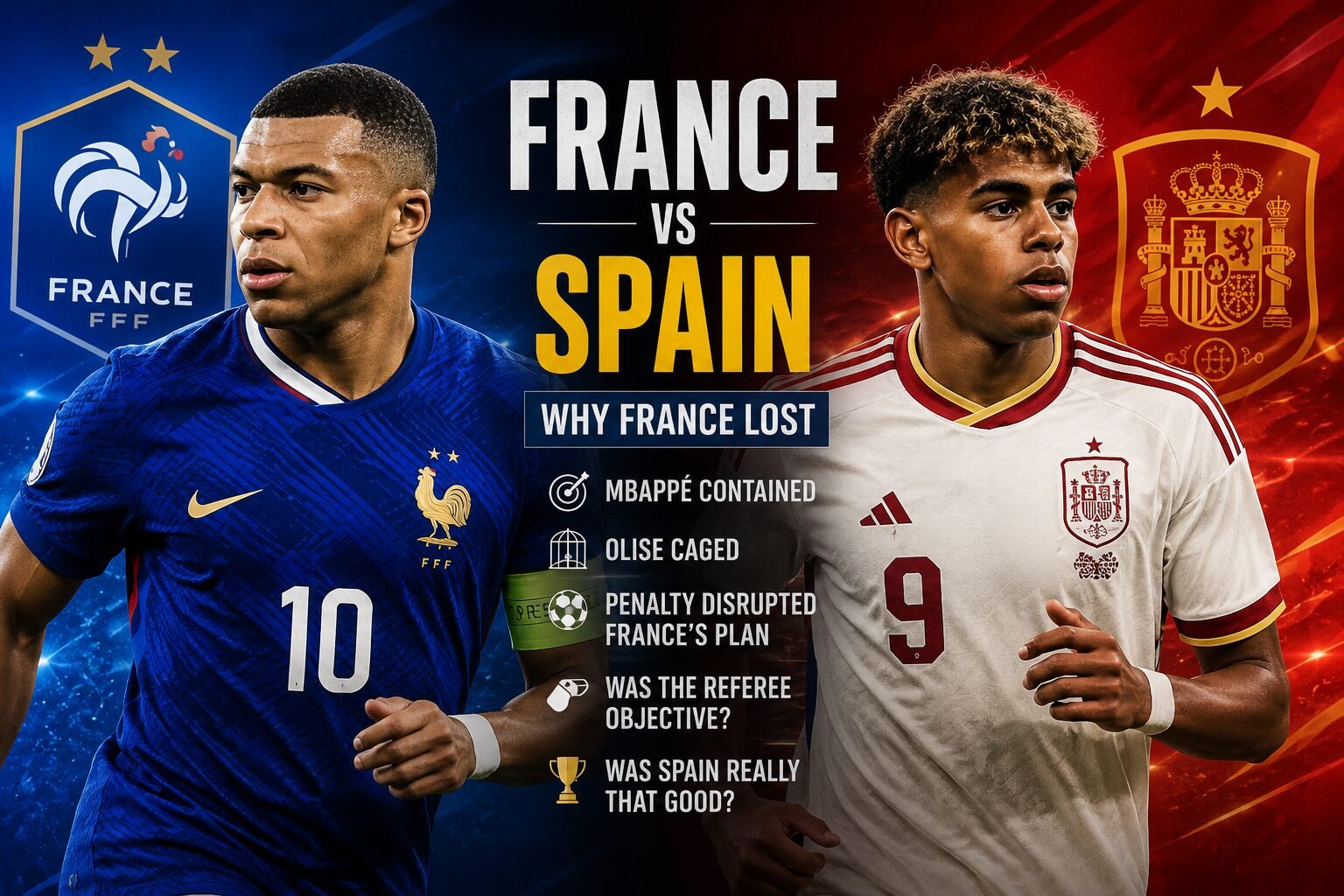
Why France Lost to Spain: The Tactical Battle That Decided the World Cup Semi Final
France entered the World Cup semi final as one of the tournament favourites. They had scored goals freely, defended well throughout the knockout stage and possessed one of the world’s most dangerous attacks.
Yet against Spain, Didier Deschamps’ side barely resembled the team that eliminated Morocco in the quarter finals. Spain won 2-0 and, more importantly, controlled almost every phase of the game as reported by AP News
Spain Won the Midfield Before They Won the Match
The biggest difference between both teams was not finishing.
It was control.
Rodri, Dani Olmo and Spain’s midfield never allowed France to dictate the tempo. Every time France recovered possession, Spain immediately pressed to win it back.
Instead of launching fast counter attacks, France spent most of the evening chasing the ball.
Spain’s patient passing forced France to defend deeper than they wanted, reducing the space available for Mbappé and Dembélé to attack.
France were simply reacting rather than controlling.
Why Kylian Mbappé Was Less Effective Than Usual
Mbappé remained France’s biggest attacking threat, but Spain never allowed him to receive the ball in dangerous situations.
Whenever Mbappé drifted wide, Spain doubled up on him.
When he moved centrally, Rodri and Spain’s centre backs closed the passing lanes before he could turn.
Rather than allowing Mbappé to run into space, Spain forced him to receive with his back to goal.
That completely changed France’s attack.
Instead of sprinting at defenders, Mbappé spent much of the match trying to create opportunities from deeper positions.
Even his best attacking moments quickly ended because Spain recovered their defensive shape within seconds.
Michael Olise Was Completely Caged
Michael Olise had been one of France’s creative stars throughout the tournament.
Against Spain, he struggled to influence the game.
Spain constantly blocked passing lanes into Olise while their full back received support from nearby midfielders whenever he tried to dribble inside.
Without space between the lines, Olise rarely faced defenders one on one.
His inability to link with Mbappé meant France lost one of their most dangerous attacking combinations.
French media, like L’ EQUIPE were particularly critical of Olise’s performance, describing him as one of France’s least influential players on the night.
The Penalty Changed Everything
For the opening twenty minutes, France were still organised defensively.
Then came the decisive moment.
Lucas Digne fouled Lamine Yamal inside the penalty area after failing to deal with a bouncing ball.
Mikel Oyarzabal converted the penalty to give Spain the lead.
More than just the scoreline changed.
Once Spain moved ahead, France could no longer remain patient.
Deschamps’ team had to push higher up the pitch, leaving more space behind the midfield.
That played perfectly into Spain’s hands.
Their passing became even more effective as France chased the game.
Was the Penalty the Correct Decision?
The incident immediately divided opinion.
Some observers argued that Lamine Yamal may have controlled the ball with his arm before the foul.
Others believed Lucas Digne’s challenge alone justified the penalty regardless of the earlier contact.
VAR reviewed the incident but did not recommend an on field review.
Under the Laws of the Game, VAR only intervenes when there is a clear and obvious error. Since the officials judged Digne’s foul to be decisive, the original decision stood.
Whether supporters agree or disagree, the decision fell within the referee team’s interpretation rather than being an obvious mistake.
Was Referee Iván Barton Objective?
Apart from the penalty, referee Iván Barton had a generally busy evening.
There was one confusing moment when he reversed a free kick decision after consulting with his officiating team, which frustrated French supporters.
However, neither FIFA nor the match officials have indicated that any major officiating error affected the outcome.
Even several French players focused more on their own performance than the referee after the final whistle.
Based on the available evidence, it would be difficult to argue that the referee decided the match.
Spain were simply the better side over 90 minutes.
Was Spain Really That Good?
Absolutely.
Sometimes a team appears poor because the opponent allows them very little.
That was exactly what happened here.
Spain recorded another defensive masterclass, limiting one of the world’s strongest attacks to very few clear chances while extending their remarkable unbeaten run.
What impressed most was their balance.
They attacked with confidence but never became reckless.
When possession was lost, they pressed immediately.
When defending, they stayed compact.
When attacking, every player understood their role.
Pedro Porro’s goal perfectly illustrated Spain’s football philosophy, with quick passing, intelligent movement and clinical finishing.
What Didier Deschamps Could Have Done Differently
France may have benefited from:
- Pressing Spain higher rather than allowing easy build up.
- Moving Mbappé into more central positions earlier.
- Providing Olise with greater support to escape Spain’s double marking.
- Introducing fresh attacking options sooner after falling behind.
Instead, Spain continued controlling possession while France gradually became more desperate.
By the time Porro scored the second goal, the contest was effectively over.
Final Verdict
France did not lose simply because of one penalty.
They lost because Spain controlled the game’s rhythm from start to finish.
Mbappé was denied the space he usually exploits.
Michael Olise was isolated.
The early penalty forced France to abandon their preferred tactical approach.
Most importantly, Spain executed their game plan almost perfectly.
While the refereeing decisions will continue to be debated, the overall performance suggests Spain deserved their place in the World Cup final.
Read Also;
Argentina’s Road to the 2026 World Cup Semi Finals: Why Every Knockout Match Has Been a Battle