

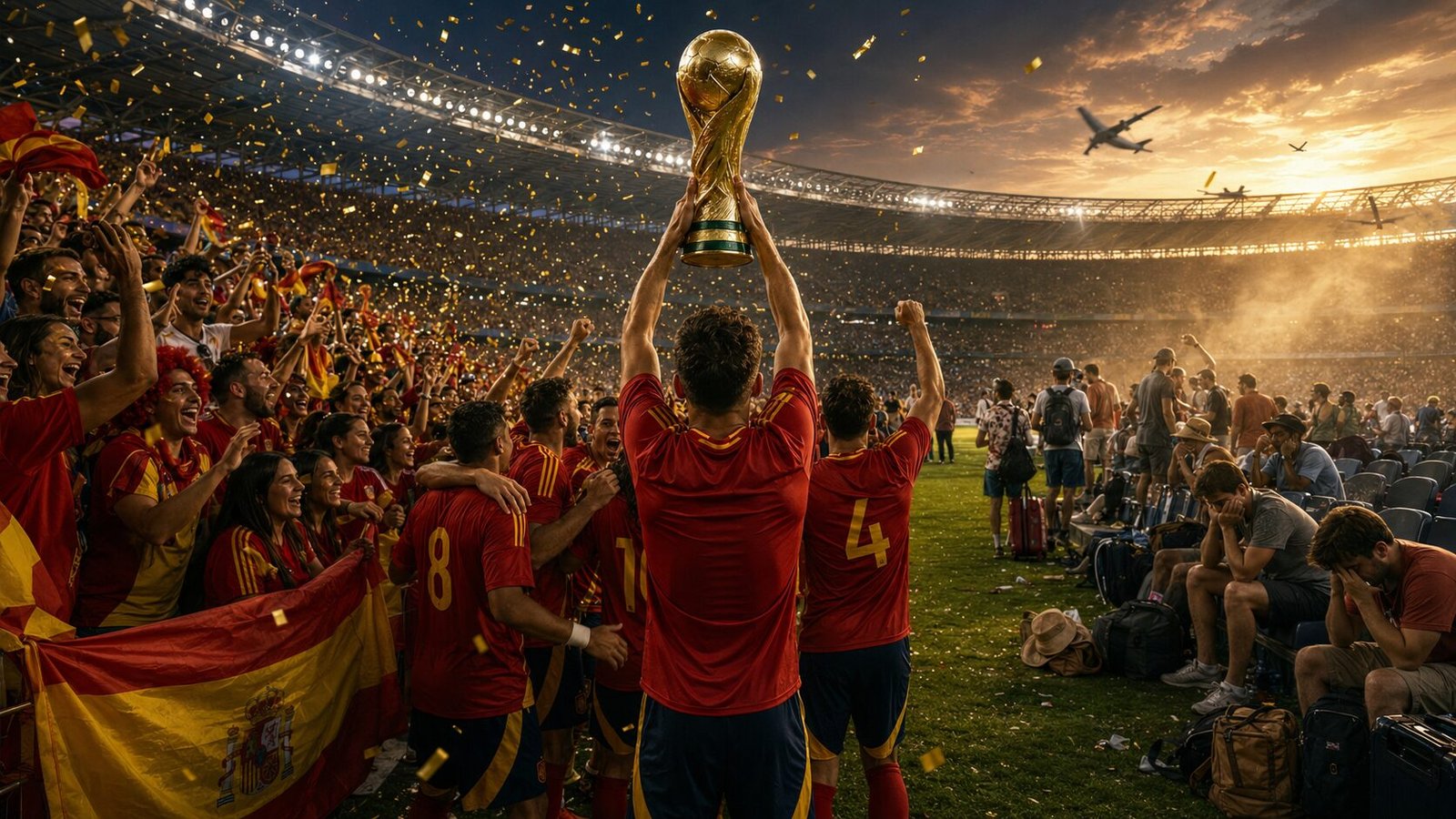
The 2026 FIFA World Cup ended with Spain defeating Argentina 1–0 after extra time at the New York New Jersey Stadium. Ferran Torres scored the winning goal in the 106th minute, giving Spain its second men’s World Cup title and ending Argentina’s attempt to win back to back tournaments.
Spain deserved its victory. It combined young talent, tactical discipline and experienced leadership throughout the competition. Argentina also deserves credit for reaching another final, but Spain proved stronger when it mattered most.
However, the 2026 World Cup was about much more than the final. It was the largest World Cup ever, featuring 48 teams, 104 matches and three host countries.
Now that the celebrations are over, it is time to examine the good, the bad, the ugly and the lessons FIFA must take into the next World Cup.
The Good: Football Became More Global
The decision to expand the World Cup from 32 to 48 teams gave more countries an opportunity to compete on football’s biggest stage.
Nations such as Cape Verde and Curaçao brought new supporters, cultures and stories to the tournament. Even when some smaller teams did not progress far, their presence made the competition more representative of the global game.
Canada also reached the knockout stage for the first time. Morocco continued to demonstrate the growth of African football, while several traditionally overlooked teams showed that the gap between football’s established powers and emerging nations is gradually becoming smaller.
The expanded format was not perfect, but it gave millions of supporters the opportunity to watch their countries participate in a World Cup. According to FIFA’s explanation of the 48-team format, the competition was designed to increase global participation while retaining four-team groups.
That objective was achieved.
Spain Confirmed a New Football Era
Spain’s victory was not simply the result of one strong tournament. It represented the continuation of a football system built around technical development, intelligent possession and trust in young players.
The team successfully combined emerging stars with experienced leaders such as Rodri. Spain did not depend entirely on one player. Different members of the squad contributed during difficult moments, making the team more balanced and less predictable.
The victory also completed a remarkable period for Spanish football following its success at Euro 2024.
Argentina entered the final with the experience of being defending champion, while Lionel Messi was chasing another historic achievement. However, Spain controlled the key moments and eventually found the breakthrough in extra time.
FIFA’s final tournament standings confirmed Spain as champion, Argentina as runner up, England in third place and France in fourth.
A Tournament That Captured America’s Attention
One of the greatest successes of the 2026 World Cup was its impact on football in the United States.
Nearly 63 million viewers in the United States reportedly watched Spain defeat Argentina in the final. The audience demonstrated that football is no longer a minor sport in the American market.
The tournament also attracted large multicultural crowds across Canada, Mexico and the United States. Supporters brought the atmosphere of South America, Africa, Europe, Asia and the Caribbean into North American stadiums.
The record television audience reported by Reuters could create long-term benefits for Major League Soccer, youth football, sponsors and the women’s game.
The tournament showed that North America can attract enormous football audiences. The next challenge is converting that temporary excitement into lasting participation.
The Bad: The Group Stage Was Too Forgiving
The expanded tournament created more opportunities, but it also reduced the level of pressure during the group stage.
Under the 2026 format, 32 of the 48 participating teams qualified for the knockout rounds. This meant that two thirds of the teams progressed.
Some countries could therefore deliver one strong performance, or avoid heavy defeats, and still qualify as one of the best third-placed teams. The arrangement made certain group-stage matches difficult to follow because teams had to compare results from different groups.
There were inspiring performances from smaller countries, but there were also one-sided matches that exposed the difference in quality between some teams.
As The Guardian’s assessment of the 48-team format noted, expansion increased representation but also produced concerns about uneven matches, confusing qualification scenarios and reduced early drama.
FIFA must find a better balance between global inclusion and competitive quality.
Travel Distances Created Unnecessary Pressure
Hosting the tournament across Canada, Mexico and the United States allowed millions of people to experience the World Cup. However, the enormous distances between cities created challenges for teams and supporters.
The tournament covered different countries, time zones and climates. Travelling between cities often required flights rather than short train journeys.
Supporters attending several matches faced additional expenses for flights, hotels, local transportation and food. Teams also had to manage travel fatigue alongside an already demanding match schedule.
Regional scheduling helped, but it did not completely solve the problem.
Future host countries should develop match schedules that reduce unnecessary movement. Teams should remain within the same geographical region for as long as possible, especially during the group stage.
The Ugly: The World Cup Became Too Expensive
The most serious criticism of the 2026 World Cup concerned affordability.
Ticket prices placed many matches beyond the reach of ordinary supporters. Dynamic pricing and expensive resale tickets created the impression that the tournament was designed primarily for corporations, sponsors and wealthy visitors.
Transportation was another concern. Some host cities introduced unusually high fares for travel to stadiums. The cost of accommodation also increased significantly in several locations.
An ESPN report on World Cup ticket prices highlighted how prices changed as the tournament approached, while supporters continued to question whether attending the competition still offered reasonable value.
A World Cup may be commercially successful, but it loses part of its identity when local families and lifelong supporters cannot afford to attend.
FIFA should introduce protected low-cost ticket categories for residents, families and registered supporters at future tournaments.
Extreme Heat and Disruptive Hydration Breaks
Player safety had to be taken seriously because several matches were played in difficult summer conditions.
Mandatory three-minute hydration breaks were introduced during both halves of every match. The breaks provided players with an opportunity to recover, but their use in all matches attracted criticism.
Some games were played in cooler conditions or covered stadiums, yet the breaks still occurred. Coaches could use them to deliver tactical instructions, while broadcasters gained additional commercial time.
FIFA maintained that the breaks did not affect match results, but confirmed that their future remains under review, according to Reuters’ report on the hydration-break policy.
Player welfare must remain the priority. However, breaks should be based on measurable temperature and humidity levels, not automatically added to every game.
Football Must Remain Bigger Than the Show
The 2026 World Cup demonstrated FIFA’s growing desire to turn football into a wider entertainment product.
Music, extended ceremonies, commercial breaks and celebrity appearances can attract new audiences. However, they should not overshadow the match itself.
The final is not the Super Bowl. Football has its own traditions, rhythm and global identity. Entertainment can complement the occasion, but the sport must remain at the centre of the event.
FIFA must be careful not to sacrifice football’s character while chasing higher advertising and broadcasting revenue.
Key Lessons Learned From the 2026 World Cup
The tournament provided several important lessons:
- Expansion can improve global representation. More countries deserve the opportunity to participate, but qualification must remain meaningful.
- Affordability must become a formal success measure. Record revenue should not be celebrated if ordinary supporters are excluded.
- Player welfare requires better scheduling. Matches in extreme heat should begin later or take place in climate-controlled stadiums.
- Regional planning can reduce travel. Teams and supporters should not be required to cross large geographical areas repeatedly.
- Technology still requires transparency. VAR and other officiating tools must produce quicker and clearer decisions.
- Host investments must provide lasting value. Stadiums, public transportation and community facilities should continue serving residents after the tournament.
- Commercial growth must have limits. The World Cup should remain a football competition rather than becoming a collection of advertising opportunities.
What Will Change at the 2030 World Cup?
The next World Cup will be different in one major way: it will become the first edition staged across three continents.
Spain, Portugal and Morocco will serve as the primary hosts. Uruguay, Argentina and Paraguay will each stage a centenary celebration match to recognize the 100th anniversary of the first World Cup.
The arrangement has historical value, particularly because Uruguay hosted and won the first tournament in 1930. However, it will also create another complicated travel and environmental challenge.
FIFA has confirmed the six-country arrangement, but the complete match schedule and several operational details remain under development.
Based on the experience of 2026, several changes should be expected or strongly considered for 2030:
- More regionalized match scheduling
- Greater control over ticket and resale prices
- Clearer rules for third-place qualification
- Improved heat-management standards
- Faster and more transparent VAR decisions
- Stronger public transportation plans
- Greater protection for travelling supporters
- Less commercial interruption during matches
The 48-team structure is expected to continue. However, FIFA should resist further expansion unless it can prove that competitive quality, player welfare and supporter experience will not suffer.
The 2026 World Cup was memorable, ambitious and commercially successful. It gave new countries a place on the global stage, attracted record audiences and confirmed Spain as the world’s leading national team.
It also exposed serious weaknesses.
High prices pushed ordinary supporters away. Long travel distances placed pressure on teams and fans. Extreme weather affected player welfare, while commercial decisions sometimes interrupted the natural flow of the game.
The tournament proved that bigger can be exciting, but bigger is not automatically better.
As football prepares for the 2030 World Cup, FIFA must decide what kind of tournament it wants to create. The lesson from 2026 is clear: protect the football, respect the supporters and allow the World Cup to remain the people’s game.
Read Also: