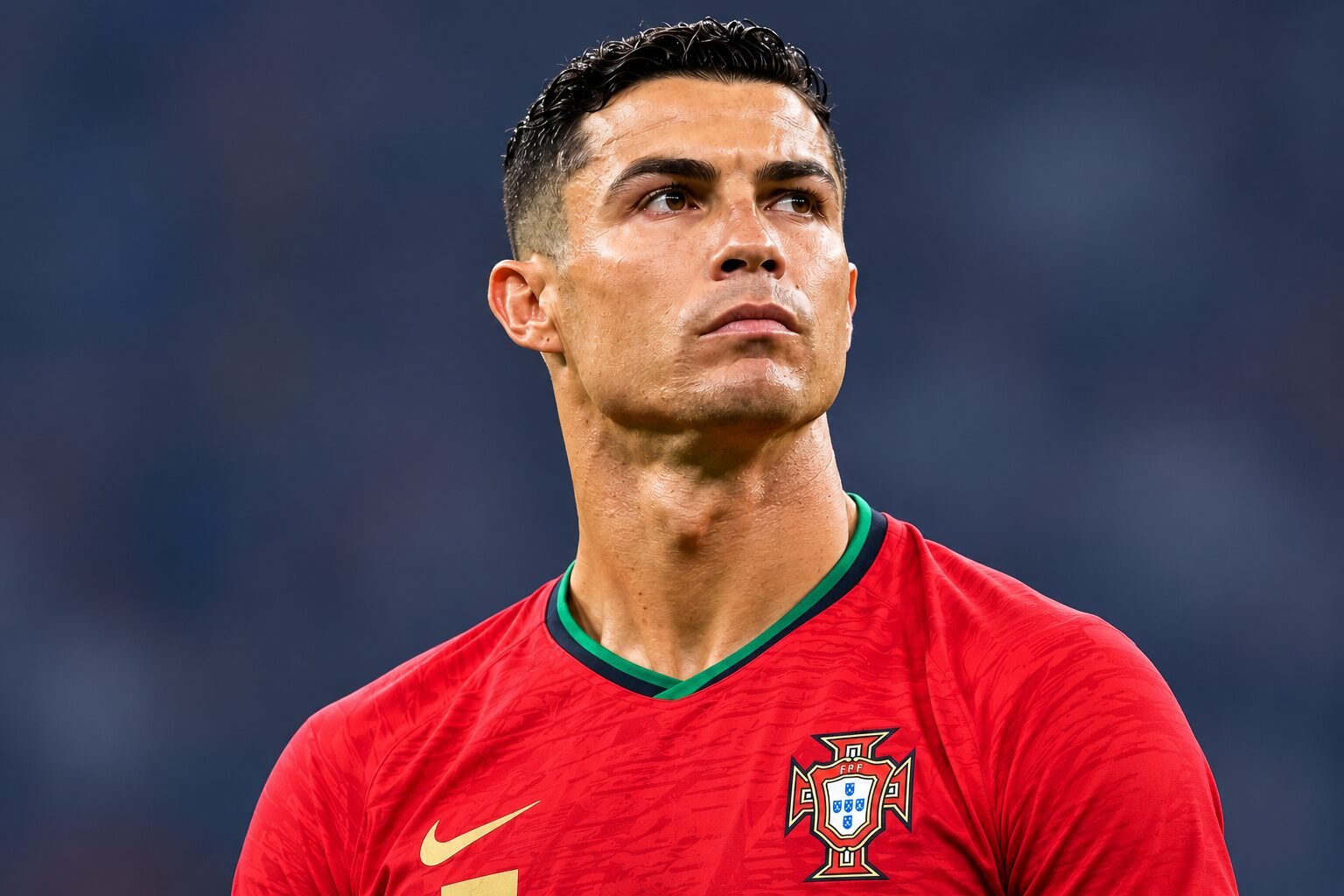
Cristiano Ronaldo has conquered European football, broken international scoring records and established himself as one of the greatest players in history. But at 41, the Portuguese superstar faces an unexpected challenge: a disciplinary suspension from the national team he has represented for more than two decades.
The Portuguese Football Federation (FPF) has provisionally suspended Ronaldo following his controversial departure from the national team camp during the October international break.
The decision follows a disagreement between Ronaldo and Portugal head coach Jorge Jesus over the veteran striker’s playing time and his role within the squad.
What initially appeared to be a disagreement over substitutions has developed into a much bigger controversy involving player authority, managerial control, national team discipline and the future of Portugal’s most decorated footballer.
For Ronaldo, the consequences could extend beyond missing a few international matches.
For Portugal, the dispute raises an uncomfortable question: Can a national team move forward without its greatest-ever goalscorer, and should it have to?
What Happened Between Cristiano Ronaldo and Jorge Jesus?
The controversy began during Portugal’s UEFA Nations League fixture against Norway on September 27, 2026.
Ronaldo was named among the substitutes and reportedly began warming up during the match.
However, despite preparing to enter the game, he remained on the bench as Portugal secured a 2–1 victory.
According to Ronaldo’s subsequent account, Jesus had previously indicated that he would receive approximately 30 minutes of playing time.
Ronaldo considered the decision not to introduce him a breach of their understanding.
The disagreement intensified ahead of Portugal’s following Nations League fixture against Denmark.
Ronaldo left the national team camp in Copenhagen after informing the Portuguese federation of his departure.
He subsequently published a lengthy statement explaining his decision and expressing frustration with the national team coach.
Jesus disputed Ronaldo’s account of their agreement.
The disagreement therefore involves two different interpretations of what was promised and what happened.
While Ronaldo believes his trust was broken, the coach maintains that team selection remains his responsibility.
The situation quickly attracted international attention because of Ronaldo’s status, his relationship with Portuguese football and the implications of a senior player publicly challenging a national team manager.
Portugal Takes Disciplinary Action
On October 10, the Portuguese Football Federation confirmed that disciplinary proceedings had been initiated against Ronaldo.
The federation’s disciplinary process followed events reported earlier in the week.
Ronaldo was placed under a provisional suspension while the matter was referred for further investigation.
Importantly, a provisional suspension is not the same as a final disciplinary punishment.
The federation has not yet announced the final length of any suspension.
Under the relevant Portuguese football disciplinary regulations, an unjustified absence from national team activities can attract a suspension ranging from one to six months, alongside a financial penalty.
However, whether Ronaldo’s departure meets the conditions for such a punishment remains subject to the disciplinary process.
Ronaldo has acknowledged that his actions may have consequences and indicated that he is prepared to accept a sanction.
This represents a significant development for a player whose international career began in 2003.
Cristiano Ronaldo’s Portugal Career: The Numbers Behind the Legend
To understand the significance of the suspension, it is necessary to examine what Ronaldo has achieved for Portugal.
According to UEFA’s September 2026 records, Ronaldo has scored 146 goals in 234 international appearances.
These figures make him the leading goalscorer and appearance holder in the history of men’s international football.
Ronaldo’s International Career by the Numbers
| Category | Record |
|---|---|
| International appearances | 234 |
| International goals | 146 |
| Goals per appearance | 0.62 |
| International debut | 2003 |
| Years representing Portugal | 23 |
| European Championship titles | 1 |
| UEFA Nations League titles | 2 |
| World Cups in which he has scored | 6 |
| Age | 41 |
Sources: UEFA and FIFA, as of October 2026.
These numbers illustrate why Ronaldo’s situation is unlike an ordinary disciplinary disagreement.
With 146 goals in 234 appearances, Ronaldo averages approximately 0.62 goals per international appearance.
That represents roughly one international goal every 1.6 appearances across a career spanning more than two decades.
His longevity is equally remarkable.
In June 2026, Ronaldo became the first male footballer to score in six different FIFA World Cup tournaments, following his two goals against Uzbekistan.
That achievement added another historic milestone to a career already defined by exceptional consistency.
Yet football is ultimately a team sport, and historical achievement does not automatically guarantee future selection.
That is the central tension in the current controversy.
Has Portugal Already Found Ronaldo’s Replacement?
One of the most interesting aspects of the dispute is how Portugal has performed without Ronaldo on the pitch.
According to Associated Press reporting, Portugal won all three matches in which Ronaldo was either an unused substitute or absent during the recent international period.
During those matches, Gonçalo Ramos scored three goals.
Portugal’s Recent Results Without Ronaldo Playing
| Performance indicator | Result |
|---|---|
| Matches | 3 |
| Wins | 3 |
| Draws | 0 |
| Defeats | 0 |
| Points earned | 9 |
| Gonçalo Ramos goals | 3 |
| Win percentage | 100% |
Source: Associated Press, October 10, 2026.
These figures create an intriguing discussion.
Portugal achieved a perfect winning record across those three matches without Ronaldo contributing on the pitch.
Meanwhile, Ramos demonstrated that he could provide goals when given opportunities.
However, three matches represent a small sample.
It would be statistically irresponsible to conclude that Portugal is permanently stronger without Ronaldo based solely on these results.
The opposition, tactical approach, quality of chances created and broader match circumstances must also be considered.
Nevertheless, the results strengthen the argument that Portugal has credible alternatives in attack.
The Ronaldo Versus Ramos Question
The issue is not simply whether Ramos can score goals.
It is whether Portugal benefits more from building its attacking structure around a younger striker or continuing to accommodate Ronaldo’s experience and finishing ability.
Ronaldo offers qualities that are difficult to replicate.
His movement inside the penalty area, international experience, aerial ability and record in major competitions remain valuable.
Ramos, however, represents a different profile.
He offers a younger attacking option and an opportunity for Portugal to develop a system less dependent on one individual.
From a tactical perspective, the decision should depend on current performance, opposition characteristics and the manager’s preferred approach.
Portugal’s challenge is to balance respect for its greatest goalscorer with the responsibility to select the most effective team.
Is Ronaldo Still Performing at the Highest Level?
Age is an unavoidable part of the conversation.
Ronaldo turned 41 in February 2026, an age at which most elite forwards have already retired from international football.
Yet his recent statistics demonstrate that he continues to contribute.
UEFA’s available 2026 European qualifying statistics show:
| Performance metric | Ronaldo |
|---|---|
| Matches | 5 |
| Minutes played | 372 |
| Goals | 5 |
| Goals per 90 minutes | 1.21 |
| Total attempts | 31 |
| Shots per match | 6.2 |
| Passing accuracy | 94.2% |
| Recorded top speed | 31.35 km/h |
Source: UEFA player statistics. These figures relate to the qualifying competition shown in UEFA’s player profile, not Ronaldo’s entire 2026 international campaign.
Five goals in 372 minutes translate to approximately 1.21 goals per 90 minutes.
That is a strong scoring rate.
It suggests that Ronaldo can still provide a meaningful attacking contribution when opportunities are created for him.
However, goals alone cannot fully measure a forward’s overall tactical contribution.
Modern international football increasingly demands coordinated pressing, defensive positioning, movement between lines and collective attacking flexibility.
A manager may therefore choose a different striker even when Ronaldo remains an effective goalscorer.
The question is not necessarily whether Ronaldo is still good enough to play for Portugal.
It is whether his preferred role aligns with the system Jorge Jesus wants to implement.
The Leadership Question: Should Ronaldo Have Walked Away?
There are two legitimate perspectives on Ronaldo’s actions.
The Argument Supporting Ronaldo
Supporters may argue that Ronaldo deserved clearer communication about his playing role.
After more than two decades representing Portugal, expectations surrounding his participation should arguably have been managed carefully.
If an agreement concerning playing time existed, failing to honour it could reasonably damage trust.
Ronaldo has also contributed significantly to Portugal’s international success.
His leadership, experience and achievements have helped elevate the country’s footballing reputation.
From this perspective, the controversy could have been avoided through better communication between the player and coaching staff.
The Argument Supporting Jorge Jesus
A national team manager must retain the authority to select players and make tactical decisions.
No footballer, regardless of reputation, should have an automatic entitlement to playing time.
If a player leaves camp because he disagrees with a selection decision, it risks creating a precedent that could undermine team discipline.
Other players may begin questioning why different standards apply to senior stars.
For Jesus, the situation is therefore about more than Ronaldo.
It concerns the authority of the coaching staff and the principle that the national team must operate under a consistent set of rules.
SoccerVAR Analysis
Both perspectives contain reasonable arguments.
Ronaldo’s achievements deserve recognition, but they do not place him above team regulations.
Equally, effective leadership requires clear communication and respect for players, particularly those with significant experience.
The most constructive outcome would involve an independent disciplinary decision, followed by a clear agreement on Ronaldo’s future role.
Neither the manager nor the player benefits from allowing a selection disagreement to become a prolonged institutional conflict.
Could Ronaldo Be Banned for Six Months?
Portuguese disciplinary regulations reportedly allow suspensions ranging from one to six months for certain unjustified absences from national team activities.
However, that does not mean Ronaldo will automatically receive a six-month suspension.
Several factors may influence the outcome.
First, the disciplinary committee must determine whether Ronaldo’s departure constitutes an offence under the relevant regulations.
Second, it must consider the circumstances surrounding his decision to leave.
Third, the committee may consider his acknowledgement of the incident and willingness to accept responsibility.
Finally, the process must establish an appropriate sanction if a breach is confirmed.
As of October 10, 2026, no final punishment has been announced.
Claims that Ronaldo has already received a six-month ban would therefore be premature.
What Happens to Ronaldo’s International Career?
The controversy has inevitably generated speculation about Ronaldo’s future with Portugal.
However, there is an important distinction between suspension and retirement.
Ronaldo has not announced his retirement from international football.
Instead, he has indicated that he remains willing to represent Portugal after any applicable disciplinary process.
Portuguese Football Federation president Pedro Proença has also expressed a desire for Ronaldo to return once the situation is resolved.
That suggests reconciliation remains possible.
Nevertheless, several questions must be answered before Ronaldo returns.
Will he accept a reduced role?
Will Jesus continue to select him primarily as a substitute?
Can both parties rebuild trust?
And will Portugal’s recent success without Ronaldo influence future selection decisions?
These questions are likely to shape the next phase of his international career.
Ronaldo’s Legacy Is Bigger Than This Controversy
Whatever happens next, Ronaldo’s contribution to Portuguese football cannot be reduced to one disciplinary incident.
He has represented Portugal since 2003.
He helped the country win the 2016 European Championship and the UEFA Nations League in 2019 and 2025.
He holds the men’s international records for goals and appearances.
He also became the first male player to score in six World Cups.
These achievements represent an extraordinary international career.
Yet sporting history also demonstrates that even the greatest players eventually face difficult transitions.
The final stages of an international career often involve changing expectations, reduced playing time and decisions about when to step aside.
For Ronaldo, the challenge may be accepting that his role within Portugal’s national team is evolving.
For Jorge Jesus, the challenge is managing that transition without unnecessarily damaging the relationship between the team and its most celebrated player.
Three Possible Outcomes
Scenario One: Ronaldo Returns After a Short Suspension
This appears a realistic possibility.
The disciplinary committee could impose a relatively limited punishment, allowing Ronaldo to return during a subsequent international window.
Both parties would need to establish clearer expectations about playing time.
Such an outcome would preserve Portugal’s access to Ronaldo’s experience while reinforcing the federation’s disciplinary authority.
Scenario Two: Ronaldo Returns in a Reduced Role
Portugal could continue developing younger attacking options while using Ronaldo selectively.
Under this arrangement, he might feature in specific matches or situations where his finishing ability offers a tactical advantage.
This would require Ronaldo to accept that starting every match is no longer guaranteed.
Scenario Three: The Dispute Accelerates His International Exit
If the relationship between Ronaldo and Jesus deteriorates further, the controversy could bring his international career closer to an end.
However, there is currently insufficient evidence to conclude that retirement is inevitable.
Ronaldo’s stated willingness to return and the federation president’s conciliatory comments suggest that the door remains open.
SoccerVAR Verdict: A Defining Test of Football Leadership
Cristiano Ronaldo’s suspension is about more than a disagreement over playing time.
It represents a clash between individual legacy and collective authority.
Ronaldo has earned his place among football’s greatest players through extraordinary performances, consistency and longevity.
His 146 international goals and 234 appearances are records that may stand for years.
But international football cannot operate solely on historical achievements.
Managers must make decisions based on the needs of the team, while players must respect the structures governing selection and discipline.
At the same time, communication and mutual respect are essential when managing an athlete of Ronaldo’s stature.
Portugal’s recent results demonstrate that the national team can win without Ronaldo on the pitch.
They do not prove that Portugal no longer needs him.
The strongest outcome would be one in which disciplinary accountability and sporting respect coexist.
Ronaldo’s legacy is already secure. What remains uncertain is how the final chapter of his Portugal career will be written.
And that may be the most compelling story of all.
Also Read:
Messi bows Out: Two decades of glory in the Albiceleste shirt – soccervar.com